
Duke Medical Center Archives Blog Category: Collection Spotlight

Happy Administrative Professionals Day!
Posted On: April 22, 2026 by Rebecca Williams
Administrative professionals are an important part of the Duke Health community. Across the Health System, they provide essential expertise and invaluable organizational support for the daily operations at Duke Health.

The Duke Administrative Professionals Affinity Group (APAG) is Duke's first affinity group for administrative professionals. During COVID, the need to connect with and support one another became more important than ever, and the group officially launched on July 1, 2021. As of 2024, the group has over 2000 members.
The Archives is proud to have some of their materials preserved in the Duke… MORE
Category: Collection Spotlight

Departmental Histories at the Archives: The Importance of Transferring Photographic Materials
Posted On: December 1, 2025 by Rebecca Williams
The Archives recently received an addition to the Department of Pediatric Records, and while the collection contains a variety of administrative, financial, research, photographic, correspondence, planning, and architectural files, the bulk of the materials recently transferred are photographs, both candid and group.
Photographic materials, e.g., prints, negatives, contact sheets, lantern slides, 35mm slides, and more, serve as a visual memory, recording a moment in time that a written record cannot document. Transferring departmental photographs and other photographic materials to the Archives not only enhances the Archives’ holdings by strengthening our collections, but it also improves retrieval of these… MORE
Category: Collection Spotlight

Preserving the Stead Family Albums
Posted On: August 7, 2025 by Rebecca Williams
This is the third post in a three-part series about Dr. Eugene A. Stead Jr. (1908-2005), professor and chair of the Department of Medicine at Duke University School of Medicine from 1947 to 1967. To spotlight the addition to and reprocessing of the Eugene A. Stead Jr. Papers, this post will discuss how the Archives preserved the scrapbooks and the steps we took to maintain context while separating materials for preservation.
The first post introduces Stead, highlighting his accomplishments and career.
Category: Collection Spotlight

The Stead Family Albums
Posted On: August 6, 2025 by Rebecca Williams
This is the second post in a three-part series about Dr. Eugene A. Stead Jr. (1908-2005), professor and chair of the Department of Medicine at Duke University School of Medicine from 1947 to 1967. To spotlight the addition to and reprocessing of the Eugene A. Stead Jr. Papers, this post will delve into Stead’s family life contained in the scrapbooks and family albums recently added to the collection, which document the history of the Stead family and illustrate the guiding influence Stead’s family life had on the work he did every day.
The first post introduces Stead,… MORE
Category: Collection Spotlight

An Introduction to Eugene A. Stead Jr.: Physician, Educator, and Pioneer of the Physician Assistant Training Program
Posted On: August 6, 2025 by Rebecca Williams
This is the first post in a three-part series about Dr. Eugene A. Stead, Jr. (1908-2005), professor and chair of the Department of Medicine at Duke University School of Medicine from 1947 to 1967. To spotlight the addition to and reprocessing of the Eugene A. Stead Jr. Papers, this post introduces Stead, highlighting his accomplishments and career, and honors his role in beginning the physician assistant program at Duke University, the first in the nation, which celebrates its 60th anniversary this year.
The second post delves into Stead’s family life. In 2020, the Archives received an addition from the Physician Assistant Historical Society of mostly… MORE
Category: Collection Spotlight

What is that Art? Ribbon Diagrams
Posted On: July 31, 2025 by Rebecca Williams
If you’ve spent any time in our reading room on the 1st level of the Medical Center Library, you might have noticed the striking and colorful ribbon illustrations on the walls in between the bookshelves! But you might not know the importance of these images to the history of protein science and scientific visualization! They are the influential work of Duke scientists Jane and Dave Richardson.
The ribbon diagrams or “Richardson diagrams” are now ubiquitous in depiction of proteins today, but they were first hand-drawn by Jane Richardson. She is widely recognized for the creation of this new visual language, first published in “Advances in Protein Chemistry” in 1981. The drawings stemmed from the realization that a general classification scheme could be… MORE
Category: Collection Spotlight

Oral Histories from the Archives: Kim Quang Đâu
Posted On: May 9, 2025 by Rebecca Williams
Oral history interviews are some of our favorite items to share from the Medical Center Archives’ collections. This month we are featuring an interview with Kim Quang Đâu, RN, MS, CNM. Josephine McRobbie interviewed her on October 19, 2022 as part of the Duke Midwifery Service and Durham Maternal Health Oral History Project.
Kim Đâu went to Duke University for undergrad and received her BS in Biology in 2001. She met Duke Midwifery Service's Amy MacDonald when she invited her to speak about midwifery to her student-taught House Course. Đâu then shadowed MacDonald during her undergraduate education, learning firsthand about midwifery. In 2007 Dau was recruited back to Duke Midwifery Service as a Staff… MORE
Category: Collection Spotlight

Black History Month: Charles Johnson
Posted On: February 20, 2025 by Rebecca Williams
“There are now, people of color all over Duke Hospital and no one thinks anything of it. That would be his legacy... He said to me that when the Black medical students began to come to do, and no longer sought him out, he understood that the institution had changed. For a very long time, they always would look around the faculty and probably take a wild guess that the one African-American physician or one of a couple, probably had some say in their being there. Right, so they will go and introduce themselves. But there came a time where that changed. And that was not probably not as early as you would think. I'm sure that was well into the 80s. And, you know, a few more of them, and fewer will come by to, you know, to get advice or counsel, and that kind of thing. But to me, his legacy… MORE
Category: Collection Spotlight

Black History Month: Joanne Wilson
Posted On: February 12, 2025 by Rebecca Williams
“It was interesting. It was 1969 when I first got here, and the hospital had sort of desegregated. And I say “sort of.” It's not a very exact term. On paper, it was, but in point of fact, it was not because there were private diagnostic clinic patients, and there were “staff patients.” In order to be a private patient, you would have to have money or insurance. Most of the African Americans and some poor whites did not have [those things]. So, they were in staff clinics, and you’ve probably seen some pictures of the clinics. They typically had two appointment times: 8 and 1. People would come very early hoping to get in line first. Some people would obviously sit there for hours waiting to be seen. There was a way of getting care and specialty care, but it was also really, really… MORE
Category: Collection Spotlight

Black History Month: Donald T. Moore
Posted On: February 7, 2025 by Rebecca Williams
“As I said before, we only had maybe three or four faculty at Duke at the time, who were black. Dr. Moore was the only black attending an OB-GYN. There was Dr. Johnson who was in internal medicine, Dr. Jacquelyne Jackson, who was there in sociology, and one other black physician in psychiatry. So once he saw me and some of the other black medical students, he invited us over to his home to meet his family. And just to kind of give us some semblance of being with someone that we could understand where we were, and kind of what we're trying to do. And he certainly gave us a lot of encouragement, in terms of being able to survive in any kind of environment. And, you know, he would constantly tell us that excellence will always prevail. So it didn't matter whether you're black, white,… MORE
Category: Collection Spotlight

Black History Month Spotlight: Brenda Armstrong
Posted On: February 2, 2025 by Rebecca Williams
“Every year we had registration, she would have a team of med students and doctors to give these kids physicals. [There] might be about 10 in the room, giving these kids physicals. She would ask for volunteers, but almost demand volunteers. They would be out there giving these kids free physicals, and that was done by her. And she kept a record on each kid, the whole thing. She kept and monitored that stuff, and tracked it all the way through the season, [making sure] that everything got better, even though they didn’t have real, real high blood pressure. But all that stuff got better as the season went along, and she kept a record of this. And then, if the kids had any kind of illness, or asthma, anything, she knew about it. [If] they needed medication, she would have medication.” … MORE
Category: Collection Spotlight

Robert L. Blake Papers
Posted On: January 27, 2025 by Rebecca Williams
The Duke University Medical Center Archives is happy to announce that the Robert L. Blake Papers have been reprocessed and are open for research. Bob Blake, as he was known to many, was a medical illustrator at Duke from 1943 to 1983 and served as Coordinator of the Department of Medical Illustration in the Duke University School of Medicine. The collection contains Blake’s professional papers and original artwork, including pen and ink drawings, pencil sketches, carbon dust drawings, scratchboard engravings, pen trials, watercolors, reprographic materials, photographs, negatives, scrapbooks, and commercially published works. Materials range in date from 1943 to 2005.
… MORECategory: Collection Spotlight

Duke 100 Centennial Spotlights
Posted On: December 3, 2024 by Rebecca Williams
Duke University was established in 1924 when James B. Duke, through the Indenture of Trust, designated a gift that transformed Trinity College into a comprehensive research university. The entire university is celebrating Duke’s centennial throughout the entire year of 2024. As part of the centennial celebrations, Duke is spotlighting important individuals from the past 100 years. This is the third and final post of our series rounding up the Duke Health individuals featured. You can find Part 1 and Part 2 here.
Category: Collection Spotlight

What Puts You on the Map? Archives Month 2024
Posted On: October 9, 2024 by Rebecca Williams
Every October, the Society of North Carolina Archivists celebrates Archives Month! This year’s theme, What Puts You on the Map?, brings to mind Duke University Medical Center’s SEDO system, a wayfinding system rolled out in 1971 that left its mark on the hospital.
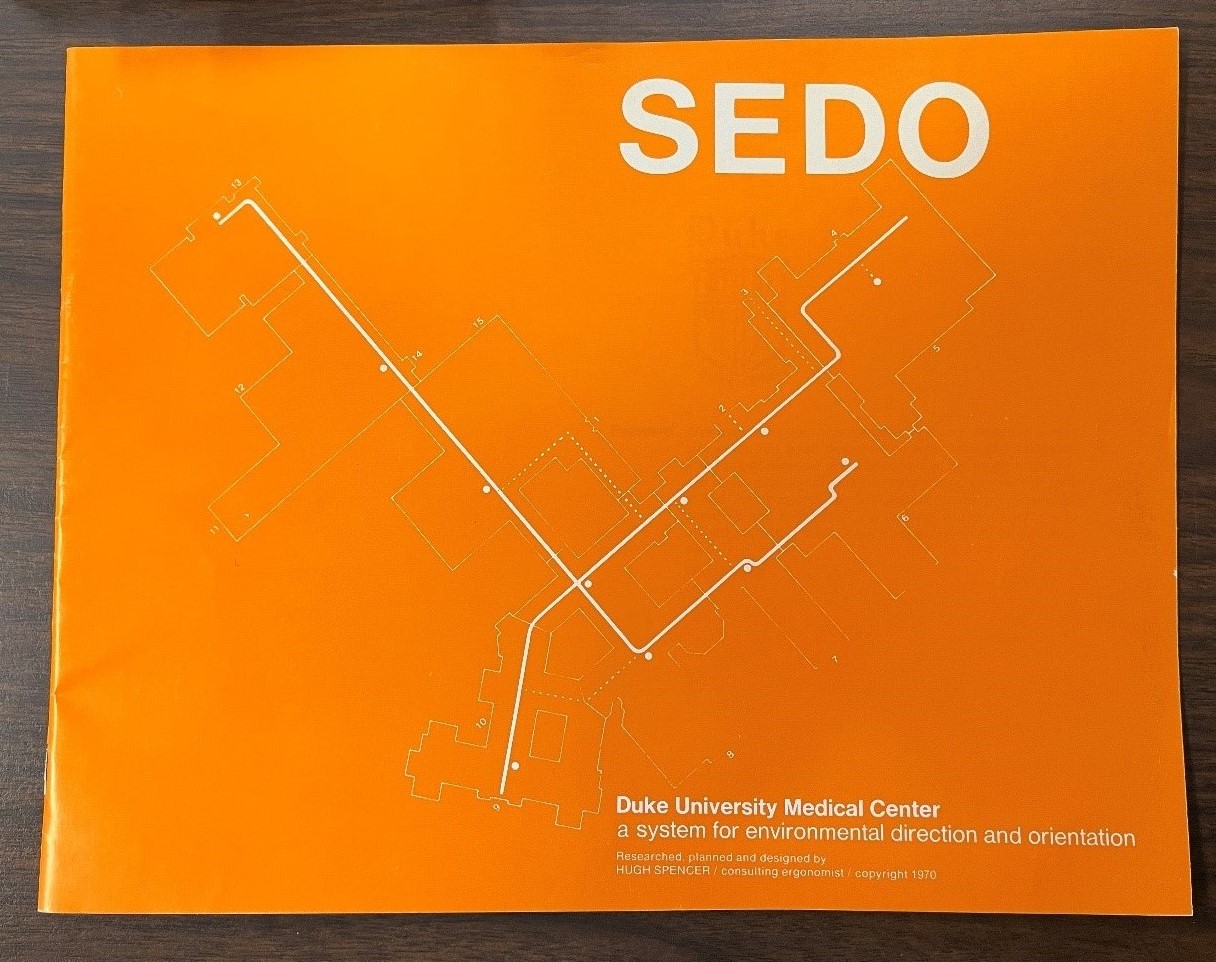
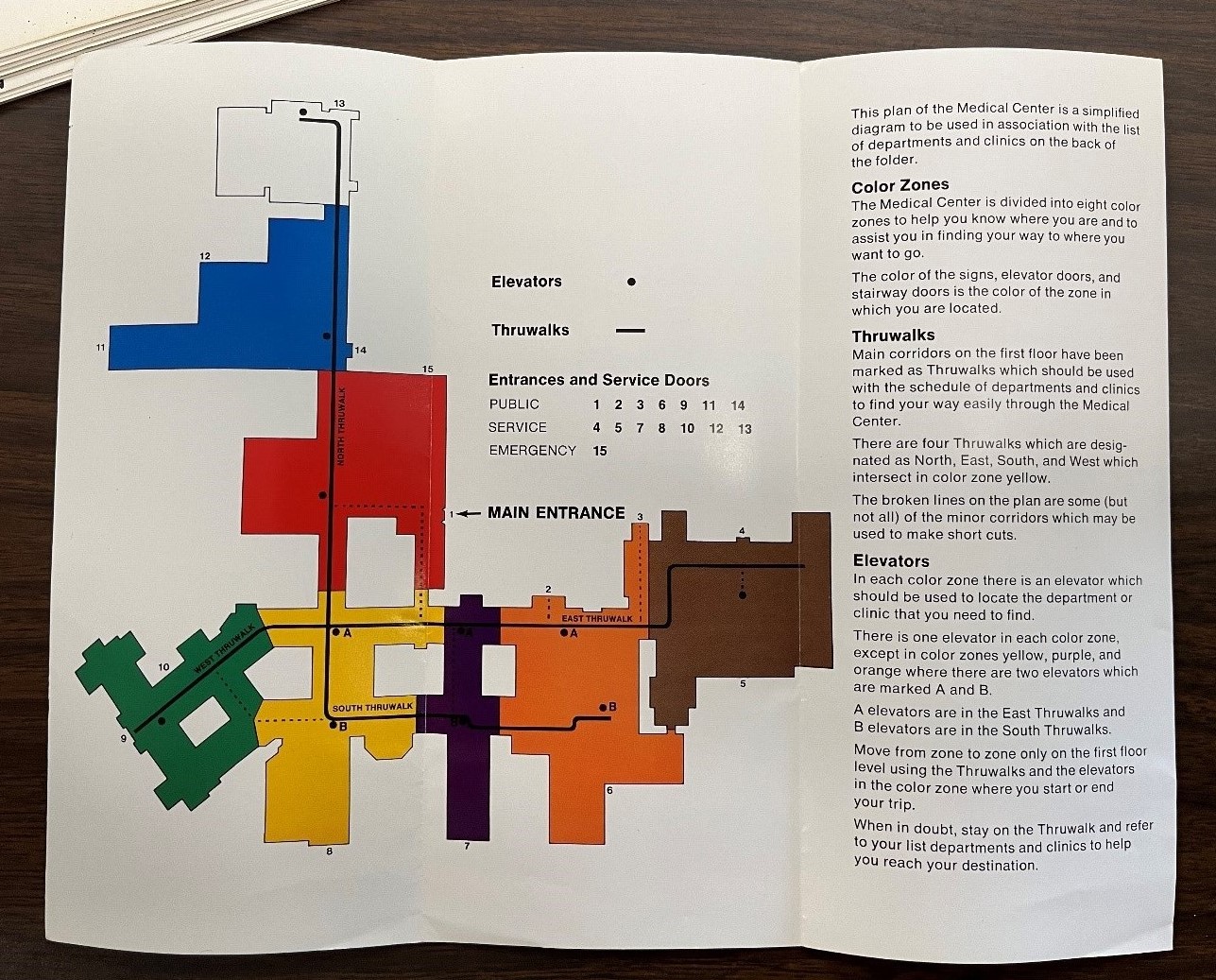
On March 5, 1971, a special issue of Intercom, the hospital’s weekly bulletin, devoted three of its four pages to the implementation of the new System of Environmental Direction and Orientation, or SEDO. SEDO was a mid-century modern wayfinding system based on eight color zones and hanging lighted signs, “similar to the… MORE
Category: Collection Spotlight

Dr. O Michael Colvin and Patients of the DCCC
Posted On: September 30, 2024 by Rebecca Williams
This is the third blog post in a three-part series exploring the life and career of Dr. O. Michael Colvin (1936-2013), renowned oncologist and educator, who served as Director of the Duke Comprehensive Cancer Center from 1995 to 2002. This blog post highlights Colvin’s dedication to his patients at the Duke Comprehensive Cancer Center.
The first blog post introduces Colvin and his work.
The second blog post discusses the impact of the National Cancer Act of 1971 on the Duke Comprehensive Cancer Center and on Colvin’s career.
“While some may believe that humans are frail creatures who give up… MORE
Category: Collection Spotlight